 Pin It
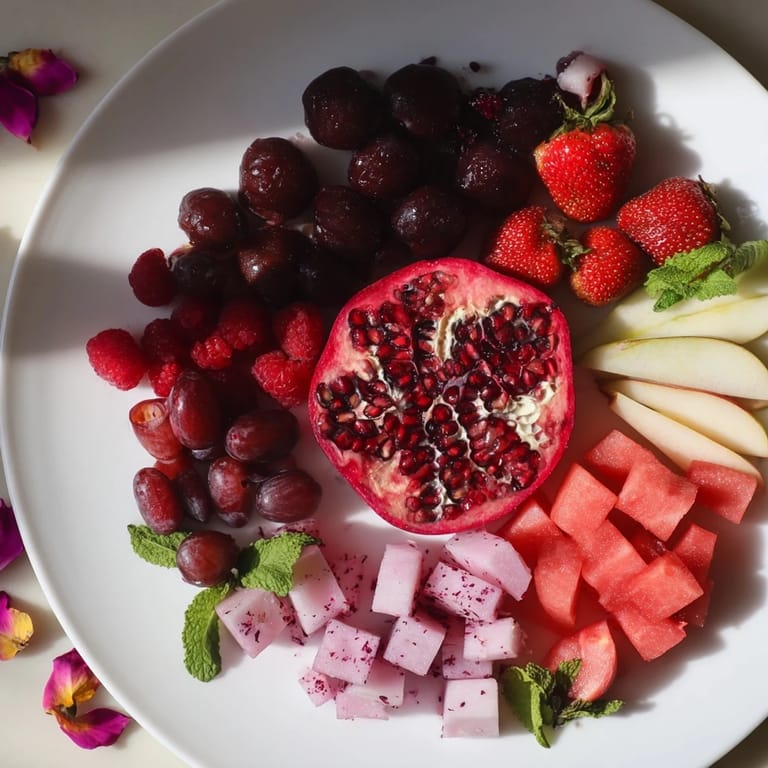
 I'd been scrolling through my phone at a dinner party when someone asked why all the fruit platters looked the same, and I found myself staring at my pomegranate sitting on the counter at home. That halved, jewel-toned center could be something extraordinary, I thought—not just a platter, but a gradient, a conversation starter, something that moved from deep crimson to pale blush like a sunset. The next weekend I gathered every pink and red fruit I could find and spent an afternoon arranging them in concentric arcs, and watching people's faces light up when they saw it made me understand that sometimes the best recipes are less about technique and more about seeing the ordinary in a completely new way.
I made this for my sister's baby shower last spring, and I remember my hands shaking a little as I positioned that halved pomegranate in the center of the platter—not from nervousness, but from the quiet excitement of doing something purely for beauty. People stood around it before touching anything, just looking, and one of my cousins whispered, "this looks like it belongs in a painting." That moment of someone pausing to appreciate your work, even though it's just fruit on a plate, is when I realized this arrangement had become something more than an appetizer.
Ingredients
- 1 large pomegranate, halved: This is your anchor, your visual and flavor centerpiece—choose one that feels heavy for its size, which means it's full of juice and seeds.
- Dark cherries, pitted (1 cup): These are your deepest reds and they glow like rubies when light hits them; if fresh cherries aren't available, use dark red plums.
- Red grapes (1 cup): Their smooth roundness creates a visual rhythm and they offer a subtle sweetness that balances any tartness.
- Strawberries, hulled (1 cup): Slice them lengthwise if you want more visual drama, or keep them whole for a neater look.
- Raspberries (1 cup): Handle these gently as they bruise easily; add them last if you're not serving immediately.
- Watermelon, cubed (1 cup): The pale pink interior creates the color transition and adds a refreshing, juicy contrast.
- Pink grapefruit segments (1 cup): These should be supremely fresh and slightly chilled for the best flavor and presentation.
- Dragon fruit, cubed (1 cup): The pale pink or white flesh with its tiny black seeds adds an almost ethereal quality to the outer ring.
- Apple slices, pink or blush varieties (1 cup): Slice them just before arranging and toss with a tiny bit of lemon juice to keep them from browning.
- Pear slices (1 cup): These should be ripe but still firm enough to hold their shape on the platter.
- Fresh mint leaves and edible rose petals (optional): These are your finishing touches—they add aroma and reinforce the artful, intentional feeling of the whole arrangement.
Tired of Takeout? 🥡
Get 10 meals you can make faster than delivery arrives. Seriously.
One email. No spam. Unsubscribe anytime.
Instructions
- Set your stage with the pomegranate:
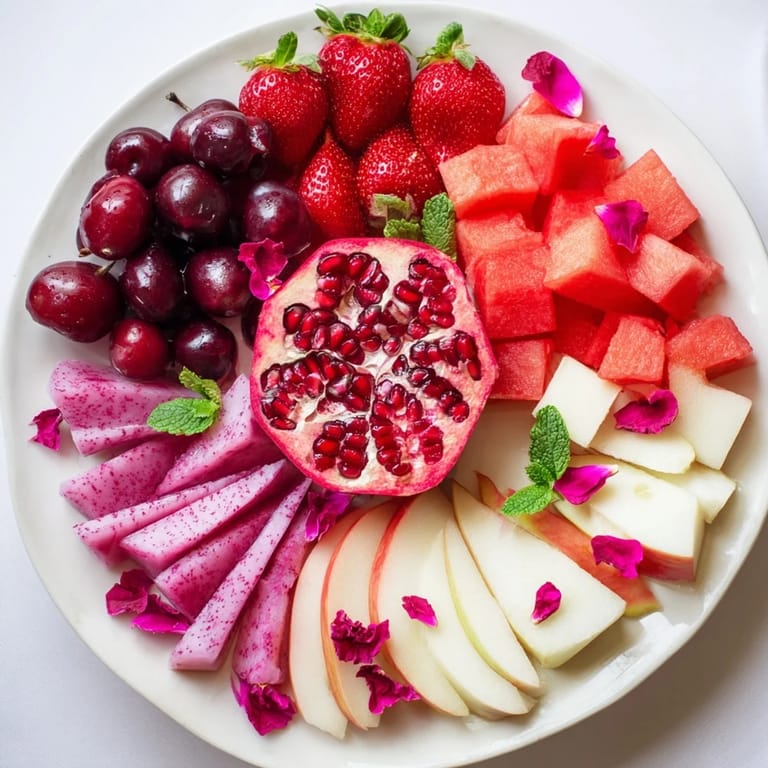
- Place that halved pomegranate cut side up dead center on your largest platter, leaving plenty of white space around it. This is your anchor, your North Star.
- Build the deep red foundation:
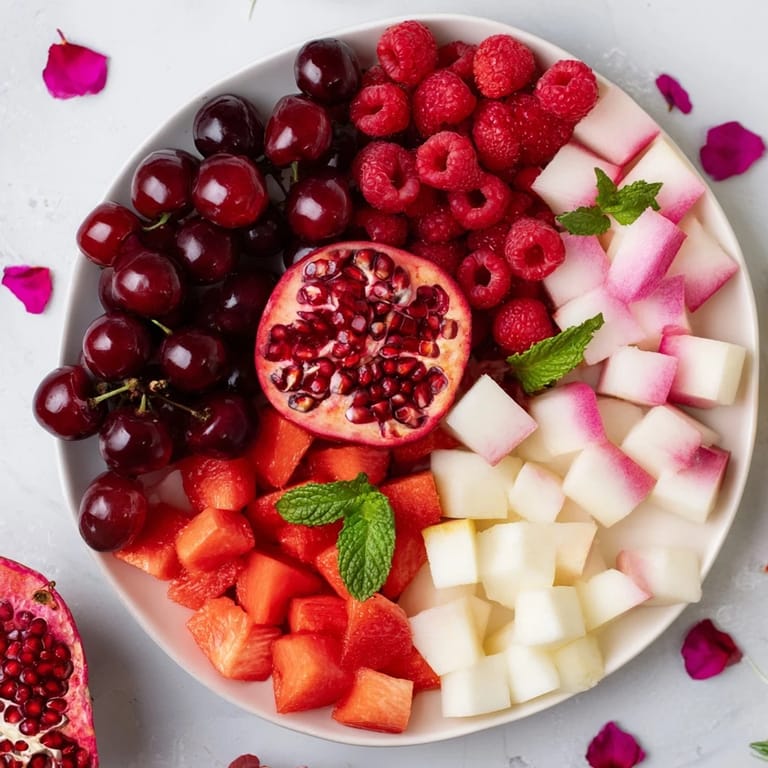
- Arrange your darkest fruits—the pitted cherries, red grapes, and strawberries—in a crescent that curves around the pomegranate like a moon. Let them nestle close enough that you see layers, not gaps.
- Create your color bridge with pink fruits:
- Next to your deep reds, lay down the raspberries, watermelon cubes, and grapefruit segments, creating a visible shift in tone but with enough overlap that the colors feel like they're flowing into each other. This is where the gradient magic starts.
- Finish with the pale outer ring:
- Place your dragon fruit, apple slices, and pear slices at the platter's edge, ensuring the lightest hues frame the deeper colors and your eye travels naturally from center to rim.
- Add the final flourishes:
- Scatter mint leaves across the arrangement and nestle a few edible rose petals into gaps—these aren't just garnish, they're the signature that says someone cared.
- Serve or hold:
- If you're serving within an hour, leave it out and let the colors stay vivid. If it needs to wait, cover loosely with plastic wrap and refrigerate; when you uncover it later, the colors will still glow.
 Pin It
 There was an afternoon when my young niece watched me arrange this platter, and instead of waiting for the adults to eat first, she asked if she could just look at it for a while longer because "it was too pretty to eat yet." That's when I understood that some recipes matter less for their taste and more for what they make people feel—which is really just another kind of nourishment.
The Color Theory Behind the Arrangement
This platter works because it follows a real principle: moving from deep, saturated colors at the center to pale, almost washed-out tones at the edges creates visual depth and draws your eye on a journey. I learned this partly by accident, partly by spending an embarrassing amount of time in fruit markets studying what looked good together, and it's made me think differently about how color moves across any plate. When you understand that arrangement can be as intentional as cooking, suddenly you're not just serving food—you're creating an experience.
Seasonal Swaps and Smart Substitutions
The beauty of this platter is that it's infinitely adaptable depending on what's at its peak when you make it. In summer, I swap in ruby red plums, sweet red currants, and blush-pink peaches. In late summer or early fall, red apples and pomegranate seeds intensify the deep end, while very pale dragon fruit or white nectarines anchor the light side. Even in winter, when choices narrow, a beautiful pomegranate, imported raspberries, and preserved grapefruit still create that stunning gradient. The recipe isn't prescriptive—it's permission to play with what you find.
Why This Works as a Centerpiece
Unlike a platter that disappears in ten minutes, this one becomes part of your table's story—it sits there while people eat, while conversations happen, while someone eventually asks how you made it look so effortless when really it's just careful arrangement and good instincts. Guests approach it differently than they approach a typical fruit bowl, and I've watched people come back to it again and again, drawn by its visual pull. The no-cook nature means you can make it hours ahead without stress, and it pairs just as well with champagne and conversation as it does at a lunch table or a casual dinner.
- Arrange fruits in overlapping layers to hide the white platter and create visual density.
- Keep all the fruit as cold as possible before plating—temperature makes colors pop and flavors taste brighter.
- If raspberries aren't available, use pomegranate seeds or red currants to fill that texture in the pink zone.
 Pin It
 Every time I make this, I think about how the simplest recipes are often the ones that teach you the most—not about cooking technique, but about intention, about paying attention to what's in front of you, and about the way beauty and nourishment can be the exact same thing. I hope this platter becomes something you make again and again, adapting it to your season and your mood.
Questions & Answers
- → How do I prevent apple and pear slices from browning?
Lightly drizzle lime juice over apple and pear slices to maintain their fresh appearance and prevent browning.
- → Can I substitute some fruits in the arrangement?
Yes, you can swap fruits based on seasonality, such as red currants, pomegranate seeds, lychees, or peaches.
- → What is the best way to arrange the fruits for visual effect?
Arrange fruits in overlapping layers with smooth color transitions for an eye-catching gradient effect around the pomegranate.
- → Are the garnishes necessary?
Garnishes like fresh mint leaves and edible rose petals are optional but add extra color and aroma to the platter.
- → What tools are recommended for preparing the platter?
Use a sharp paring knife, cutting board, large serving platter, and small bowls to hold fruits during arrangement.